









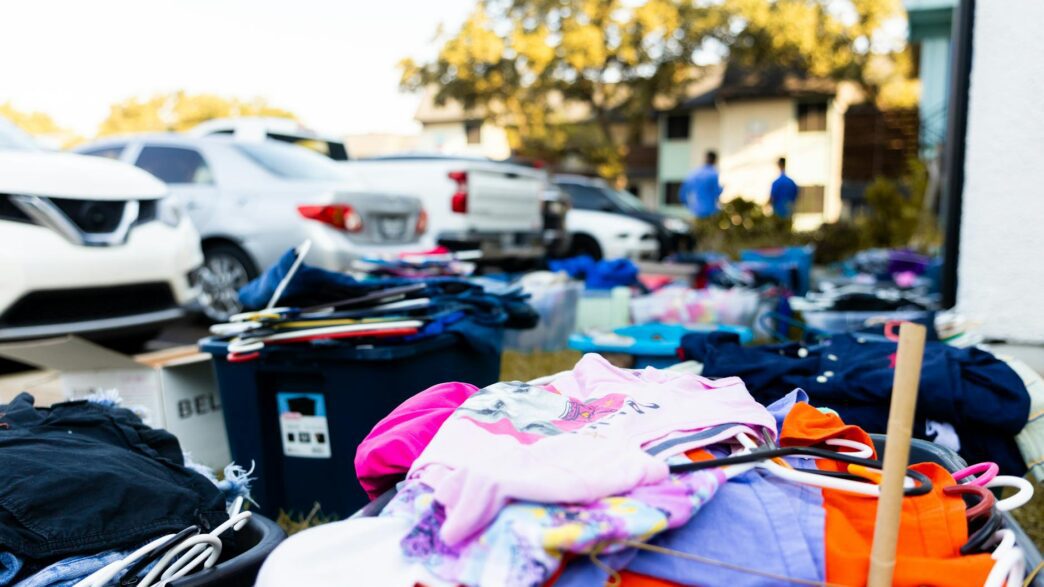
If you walked through your house right now with a notepad, you would probably find a few hundred dollars sitting in your closets, your garage, and that hallway drawer you have not opened since 2024. Old electronics, baby gear your kids outgrew two summers ago, a pile of jeans that no longer fit, kitchen gadgets that seemed essential during one specific Pinterest phase. None of it is doing anything for you, and most of it is worth real money to someone else.
Late spring and early summer is the sweet spot for offloading this stuff. People are doing yard work, setting up nurseries, moving into rentals, refreshing wardrobes for vacations, and generally spending more time scrolling Facebook Marketplace at 9 p.m. than they will all winter. If you have been meaning to start an emergency fund, beef up a high-yield savings account, or just stop dipping into checking every month, a couple of weekends of clearing things out can fund the whole project.
The clutter is worth more than you think
The numbers around household clutter are honestly a little shocking. The average American home contains more than 300,000 items, and clutter statistics tracked across recent surveys show households waste around $2.5 billion a year on stored possessions they never use, plus another $500 a year per household replacing things they already own but cannot find. Decluttering studies consistently land on a number near $300 in annual savings on duplicate purchases alone, just from being able to see what you have.
That is before you sell anything. Actually putting items in front of buyers turns invisible value into deposits. One Medium writer documented his Facebook Marketplace experiment and pulled in $1,640 in 50 days selling things he already owned, while reseller earnings reports compiled for 2026 show casual Poshmark sellers averaging $500 to $2,000 a month and active Mercari sellers in the $400 to $1,500 range. You do not need to become a reseller. You just need to take pictures of stuff you do not want anymore.
Pick the right platform for what you are selling
This is where most people lose money before they start. Different platforms favor different categories, and the fee structures can quietly eat 20 percent of your check if you are not paying attention.
Facebook Marketplace is the right choice for anything heavy, bulky, or hyper-local. Furniture, baby gear, exercise equipment, lawn tools, kitchen appliances, kids’ bikes. There are no selling fees on local pickup transactions, which means whatever a buyer hands you in cash or sends through a payment app is yours. Shipping through Marketplace does carry a 10 percent fee or a $0.80 minimum, so try to stick to local pickup when you can.
Poshmark is built for clothing, shoes, handbags, and accessories. The fee is a flat $2.95 on sales under $15 and 20 percent on anything above that, which is steep, but the buyer audience is enormous and people are there specifically to buy used clothes. Mercari competes for the same shopper with a smaller commission, around 10 percent plus a small payment processing fee, and is friendlier for general merchandise like electronics, toys, books, and home goods.
eBay still beats everyone for collectibles, vintage, and anything with a niche audience that knows what it is looking at. A 1990s lunchbox or a partially used craft kit might draw nothing on Marketplace and trigger a bidding war on eBay.
A common pattern among people who treat this as a real side income is to list across multiple platforms at once. A cross-platform study by Earning a Living Online found that multi-channel sellers consistently take home more money than people who stay loyal to one app, even after you account for the extra time spent managing listings.
Price like you actually want to sell
The fastest way to turn a Saturday into a wasted afternoon is to price your stuff based on what you paid for it. Buyers do not care. They care about what a similar used item sold for last week. Before you list anything, search the platform for the exact item, filter by sold or completed listings if the platform allows it, and price slightly below the median. The goal is not to wring the maximum dollar out of every transaction. The goal is to convert clutter into cash quickly, then redirect that cash into something that earns interest.
A few rules of thumb that resellers swear by. Electronics lose value fast, so list them within a month of deciding you do not want them. Clothing should generally start at 25 to 35 percent of retail unless it is a designer brand, in which case Poshmark’s audience will pay more. Baby gear holds value remarkably well, especially strollers and high-end carriers. Furniture priced for quick local pickup at half of what you paid will usually be gone the same week.
Good photos matter more than long descriptions. Natural light, a clean background, multiple angles, and one shot that shows scale. If you are selling a piece of furniture, take a photo of it actually in a room rather than shoved against a basement wall. People are trying to picture it in their house.
Where to put the money so it stops being clutter cash
This is the part most people skip, and it is the part that turns a one-time cleanup into actual savings. If you sell $400 in stuff and it lands in your checking account, it is going to get spent. That is just what checking accounts do. The friction is too low.
The simplest move is to open a high-yield savings account at an online bank and route every dollar of resale income there the moment it hits your account. The FDIC insures online savings accounts up to $250,000 per depositor per insured bank, same as your brick-and-mortar bank, and the top online accounts have been paying around 4.00 to 4.50 percent APY in recent rate surveys. Even at the lower end, parking $1,200 of resale income there for a year produces nearly $50 in interest without any additional effort, while $400 in checking earns nothing and disappears into dinner out and a target run.
If you are paid through PayPal, Venmo, or Cash App, transfer the money out the same day you receive it. Linked balance accounts feel like savings but typically pay much less than a dedicated high-yield account, and balances above a few hundred dollars are not always covered by pass-through FDIC insurance the way people assume. The Consumer Financial Protection Bureau has warned that funds stored in payment apps may not be insured if the company fails, so moving the money out is both a savings move and a safety move.
You can also use clutter cash as a starter deposit for a separate goal account. Some banks let you create multiple savings buckets under one account, which makes it easy to label one specifically as “vacation,” “car repair fund,” or “Christmas.” Watching that bucket grow from resale deposits is more motivating than watching one big general savings number creep up.
A realistic three-weekend plan
Most people who try to declutter their entire house in one Saturday quit by 11 a.m. and never come back. A more sustainable rhythm is one room per weekend for three weekends, with one batch of listings going out per room.
The first weekend handles closets. Pull out everything you have not worn in twelve months, photograph the items worth more than $15 individually, and bundle the cheaper stuff into mixed lots on Mercari or Poshmark. The second weekend tackles the garage, basement, or storage room, which is where the higher-dollar items live. Tools, sports equipment, camping gear, that exercise bike. Furniture goes on Marketplace with local pickup only. The third weekend is for the small stuff. Kitchen gadgets, books, kids’ toys, old electronics. Bundle aggressively. A box of mixed Lego priced at $25 will move faster than ten individual sets.
A respectable target for three weekends of effort is $400 to $800. Some households do considerably better. NerdWallet’s coverage of side income strategies routinely highlights resale as one of the more accessible ways to generate cash quickly because the inventory is already paid for and the startup costs are zero.
The point is not to become a reseller. The point is to convert the value that is already sitting in your house into deposits you can actually spend on the things you care about, or save toward the goals you keep talking about. Closet to camera to checkout to high-yield savings. That is the whole pipeline.