





Hurricane season officially opens June 1, and for once the federal forecast is on the friendlier side. NOAA’s 2026 outlook calls for a below-normal Atlantic season, with 8 to 14 named storms, 3 to 6 hurricanes, and 1 to 3 majors. A developing El Niño is doing the heavy lifting on the suppression side. That sounds like an excuse to skip the prep, but it isn’t. “Below normal” still works out to several hurricanes, and as the Red Cross keeps pointing out, a single storm hundreds of miles inland can still knock your power, your ATM network, and your debit card terminal offline for a week.
So before you fire up the grill on Memorial Day, take twenty minutes for the unglamorous part of hurricane prep: the money kit. Specifically, the question of how much actual cash to have sitting in your house when the lights go out.
Why your debit card is the wrong plan
Modern wallets are basically a phone, a debit card, and a vague hope. That works fine until a Category 2 takes out the local cell tower or floods the substation feeding your favorite gas station. When power is down, card readers don’t read. When the network is down, even the cash registers that have batteries can’t authorize a swipe. ATMs that are still standing physically often can’t dispense because they need both power and a working data connection to the bank.
This isn’t theoretical. After Hurricane Helene in 2024, parts of western North Carolina went weeks without reliable card processing because cell service was destroyed. People who had cash bought generators, gas, and groceries. People who didn’t sometimes traded car phone chargers for sandwiches. The lesson keeps repeating because most of us forget it between storms.
The fix is to set aside a small, deliberate stash of physical cash. Not a survivalist bunker, just enough to bridge a few days of normal-life expenses if the digital plumbing goes down.
How much cash to actually keep at home
Most personal finance experts land in the same range. Bankrate’s guide on emergency cash suggests $300 to $1,000 for the average household, with the higher end aimed at people in disaster-prone regions. KeyBank’s financial wellness team recommends three to five days of essential spending. CNBC’s reporting on the same question puts the typical advice at $300 to $500 as a baseline, climbing toward $1,000 in hurricane country.
If you want a more precise number, here’s a back-of-the-napkin formula: add up everything you put on cards last month, plus any cash you withdrew, then divide by ten. That’s roughly three days of your real spending pattern. A household running through $4,500 a month in cards and ATMs needs about $450 in standby cash to keep functioning normally for a long weekend without electronic payments.
Two adjustments. First, if you have a baby, a chronic medication, a generator that drinks gas, or a pet that eats a specific food only the chain pet store carries, bump the number up. Second, if you’re a homeowner in a flood zone or anywhere along the Gulf or Southeast coast, lean toward the upper end. You’re more likely to actually use it.
What you do not want is to keep an enormous pile of cash in the house. Anything beyond about $1,000 starts losing real value to inflation, becomes a theft and fire risk, and isn’t covered by your bank’s FDIC insurance because, well, it isn’t in the bank. The whole point is a bridge, not a vault.
Break it into small bills
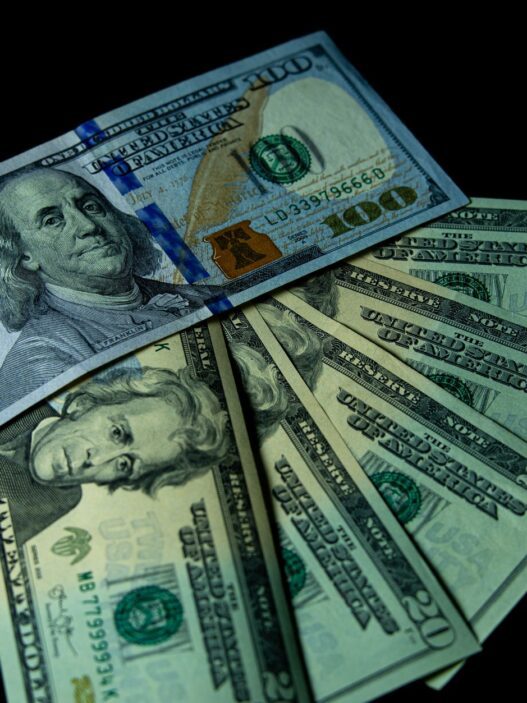
A single $100 bill is almost useless in a hurricane aftermath. Nobody at the makeshift roadside fuel stand has change for it, and you don’t want to hand it over for a $14 bag of ice. Pull your cash in twenties, tens, and fives, with a stack of singles for tips and small purchases. A working mix for a $500 stash might be ten twenties, twenty tens, twelve fives, and forty singles. That’s $500 you can actually spend without negotiating change.
Store it somewhere fireproof, waterproof, and not where a burglar would look first. A small lockbox bolted to a closet shelf works. So does a waterproof bag inside the freezer, which sounds odd but is genuinely standard advice; freezers tend to survive house fires longer than the rest of the house. Whatever you choose, tell one trusted person where it is in case you’re not home when it matters.
Build the rest of the financial go-bag
Cash is the headline, but it’s not the whole kit. FEMA publishes the Emergency Financial First Aid Kit, a checklist of the documents and account information you’d want if you had to evacuate in an hour and reconstruct your financial life from a hotel room. The agency notes that only 48 percent of Americans have basic emergency supplies on hand and just 39 percent have an emergency plan, even though roughly 60 percent of us will go through a significant disaster at some point.
The kit’s core items: copies of driver’s licenses and passports, the deed or lease, auto titles, insurance policies (homeowner’s, flood, auto, health), the front and back of every card in your wallet, a recent bank statement showing account and routing numbers, and a list of automatic bill payments. Put paper copies in a waterproof folder with the cash, and put scans in encrypted cloud storage so you can reach them from your phone.
While you’re at it, write down the customer service phone numbers for your bank, your insurance carrier, and your credit card issuers on an actual piece of paper. Those numbers live in your phone right now, which is unhelpful when your phone is dead.
Set up account access redundancy
Plenty of people get caught after a storm because all of their money is at one online-only bank whose login flow requires a text code to a phone with no signal. Two-factor authentication is great for security, but it can lock you out at exactly the wrong moment.
If you bank exclusively online, open a small checking or savings account at a local credit union or community bank too. Keep a few hundred dollars in it and order paper checks. Branches with backup generators are sometimes the only functioning piece of financial infrastructure in a disaster zone, and a teller can verify your ID in person when the app’s facial recognition won’t.
Set up at least one backup withdrawal method: a savings account at a different institution from your checking account, a credit card with no recent fraud lock, and ideally a debit card from a second bank in a different network. The goal is that when one piece fails, you have another that works.
After the storm: the financial cleanup checklist
The first 48 hours after a hurricane are about safety. Days three through fourteen are about money. The Consumer Financial Protection Bureau recommends calling lenders and card issuers as soon as you can to ask about hardship deferrals; most major banks offer 30 to 90 days of payment relief after a federally declared disaster, but only if you ask. Document everything for insurance claims with photos before you clean up, and keep receipts for hotel stays, food, and any storm-related purchases because much of it may be reimbursable.
Watch for scams. Post-disaster fraud always spikes: fake contractors demanding cash up front, phishing texts pretending to be FEMA, and “limited time” insurance settlement offers from people who don’t represent your carrier. If something feels rushed, slow down. Real disaster aid doesn’t have a 24-hour deadline.
The 20-minute pre-season checklist
Set aside one afternoon before June 1. Withdraw $300 to $500 in small bills from your bank and stash it somewhere fire- and water-safe. Pull up the FEMA EFFAK and fill in the blanks for your accounts. Photograph the front and back of every card in your wallet and store the scans in a password manager. Make sure you have a second functioning bank account and a credit card with available balance. Write down three customer service numbers on paper. Set a reminder to check that the cash is still there on December 1, which is the day after the season ends.
The whole thing takes less time than mowing the lawn. If 2026 turns out to be the quiet season NOAA expects, you’ll have spent a Sunday afternoon and roughly half a percent of your savings to feel prepared. If it doesn’t, you’ll be the household at the gas pump with a stack of twenties while everyone else is staring at a card reader that won’t beep. Either way, you win.