






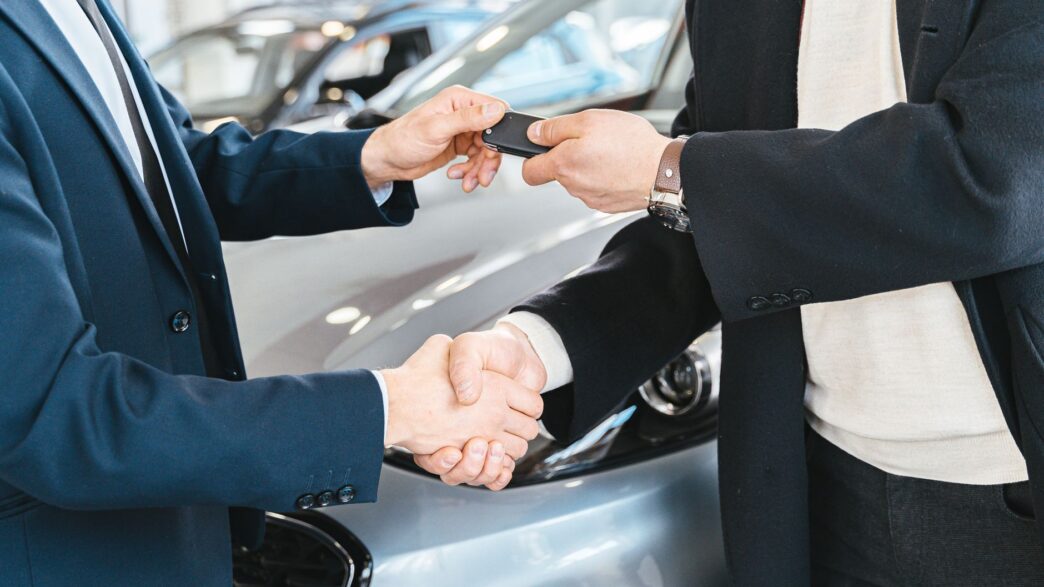
Your old car is worth more than it used to be, and the dealership knows that before you do.
Edmunds found that drivers who traded in a vehicle during the second quarter of 2026 carried an average of $13,330 in positive equity, the highest figure the company has ever recorded. That is real money parked in your driveway. The only question is whether you hand a chunk of it to a dealer in exchange for a fast, easy transaction, or spend a few weekends collecting it yourself.
The answer depends on three things nobody mentions in the showroom: what your state does with sales tax, what your weekends are worth, and whether you can take payment from a stranger without getting burned. That last one is where private sales go wrong, and it has almost nothing to do with cars.
Why the dealer’s offer is lower than the price on the lot
Start by understanding what you are being offered. A dealer is not buying your car to drive it. They are buying it to resell it, which means their offer is the expected retail price minus reconditioning and minus their margin.
Reconditioning is not trivial. Tires, brakes, a detail, a safety inspection, and whatever the lot tech finds once it goes up on the lift. Add the cost of floor-planning the car while it sits, and dealers typically build in a margin in the neighborhood of 15% to 25% on top of that. So a car that will wear a $19,900 windshield sticker might be appraised at $14,800, while a private buyer would have paid somewhere around $17,000 for the same vehicle.
The market backdrop makes that spread worth chasing. Cox Automotive put the average used-vehicle listing price at $27,028 in July 2026. Edmunds reported that the average three-year-old used vehicle hit a record $32,461 in the second quarter of 2026, up about 4% from a year earlier and 15.5% from 2021. Cheap used cars are genuinely scarce, and buyers know it. If your car is clean, boring, reliable, and priced sensibly, it will sell.
The sales tax credit changes the math more than people expect
In 41 states, trading a vehicle in reduces the amount of sales tax you owe on the car you are buying. Tax gets calculated on the difference, not the full purchase price. Trade a $12,000 car toward a $35,000 purchase in one of those states and you pay tax on $23,000. At a 7% rate, that credit is worth $840 that never leaves your bank account.
Seven states do not allow it: California, Hawaii, Kentucky, Maryland, Michigan, Montana, and Virginia. Michigan is a partial case, capping the credit at $12,000 for 2026 and raising it by $1,000 each year until the cap disappears in 2029. Washington’s Department of Revenue publishes a plain explanation of how the credit works in states that offer it, and your own state’s revenue department will have something similar.
So the comparison is not “private party price versus trade-in offer.” It is private party price versus trade-in offer plus the tax you avoid. If a private buyer pays you $2,200 more but the trade-in would have saved you $840 in tax, your actual gain from selling it yourself is $1,360. Still worth it for most people. Not obviously worth it if you were only ahead by $900 to begin with, and not worth it at all if the dealer’s offer is within a few hundred dollars.
If you live in one of the seven states with no credit, the trade-in convenience is costing you the full spread.
Get three real offers before you decide anything
Guessing what your car is worth is how people leave money behind. Spend an hour getting actual numbers instead.
Request instant cash offers from CarMax and Carvana, then take the car to one dealer that sells your brand and ask for an appraisal with no purchase attached. Those three numbers give you a floor. Compare that floor against Kelley Blue Book and Edmunds private-party values for your exact trim, mileage, and condition, and be honest about condition. Everyone thinks their car is in excellent shape. Most cars are in good shape.
Instant cash offers vary wildly with mileage rather than model year, so do not assume a national average applies to your car. A high-mileage sedan can get an offer that is thousands below private-party value, while a low-mileage truck may get an offer that is close enough to make the whole exercise pointless.
What selling it yourself actually costs
The private-party premium is not free money. You pay for it in time and small expenses.
Expect to spend money on a real detail, maybe $150 to $250, because photos of a dirty interior cost more than that in negotiating power. Some states require a current safety or emissions inspection before a title transfer, which is another appointment. Then come the messages, most of which are from people who will not show up, people who want you to drive the car to them, and people opening with an offer of 60% of asking.
Plan on two or three weekends. If your schedule genuinely does not have that in it, the dealer’s convenience fee may be a fair trade, and there is no shame in saying so.
Getting paid is the part that goes wrong
Fake cashier’s checks are the most common scam in private vehicle sales, and the reason they work is a banking rule most sellers misunderstand.
When you deposit a cashier’s check, your bank makes funds available on a schedule set by federal regulation. Available is not the same as collected. The money shows up in your app, you sign the title, and two weeks later the check comes back as counterfeit and the bank claws the funds back out of your account. The buyer and your car are gone. Autotrader keeps a running list of the variations, including the overpayment trick, where a buyer sends a check for $5,000 more than the agreed price and asks you to wire back the difference, and the fake escrow service with a convincing website and a confirmation email for money that does not exist.
The fix is simple and slightly inconvenient. Do the transaction at a branch during banking hours, ideally the buyer’s bank, and let a teller confirm the funds in front of both of you. If the buyer pays by wire or by an instant transfer service, watch the money post to your own account in your own app before the title leaves your hand. If they pay by cashier’s check, call the issuing bank using a number you looked up yourself, not the number printed on the check.
Avoid peer-to-peer apps built for splitting dinner. Their limits are too low for a car and their buyer-protection rules were not written for vehicles. A wire transfer is the usual answer above a few thousand dollars, and it has the advantage of being close to irreversible once it settles, which protects you rather than the buyer.
Once the money clears, send your state’s release of liability form the same day. In most states the plates stay with you, and your insurance stays in force until the title transfer is recorded, so cancel coverage after the paperwork is filed rather than the moment the car pulls away.
Where the proceeds should sit
If you are selling before you buy, the sale money needs somewhere to live for a few weeks. A high-yield savings account at an online bank pays meaningfully more than a checking account and keeps the cash out of everyday spending, which matters more than the interest. Money sitting in checking has a way of becoming smaller money.
And when the new car arrives, pull up your auto policy before the renewal hits. Coverage that made sense on a ten-year-old commuter often does not match what you just bought, in either direction.
When trading in is simply the better answer
Trade in without agonizing if you owe more than the car is worth, because rolling negative equity into a private sale means bringing cash to the title transfer. Trade in if the car is worth under about $4,000, where the spread rarely justifies the hassle. Trade in if you would be selling in a state with a generous tax credit and the offers came back close. And trade in if the idea of strangers at your house is a hard no, which is a legitimate reason and not a financial mistake.
For everyone else, the record equity sitting in your driveway is worth two weekends and one trip to a bank lobby.