








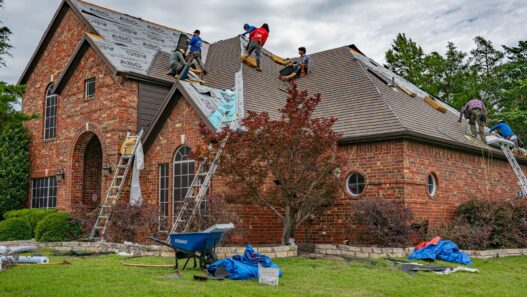
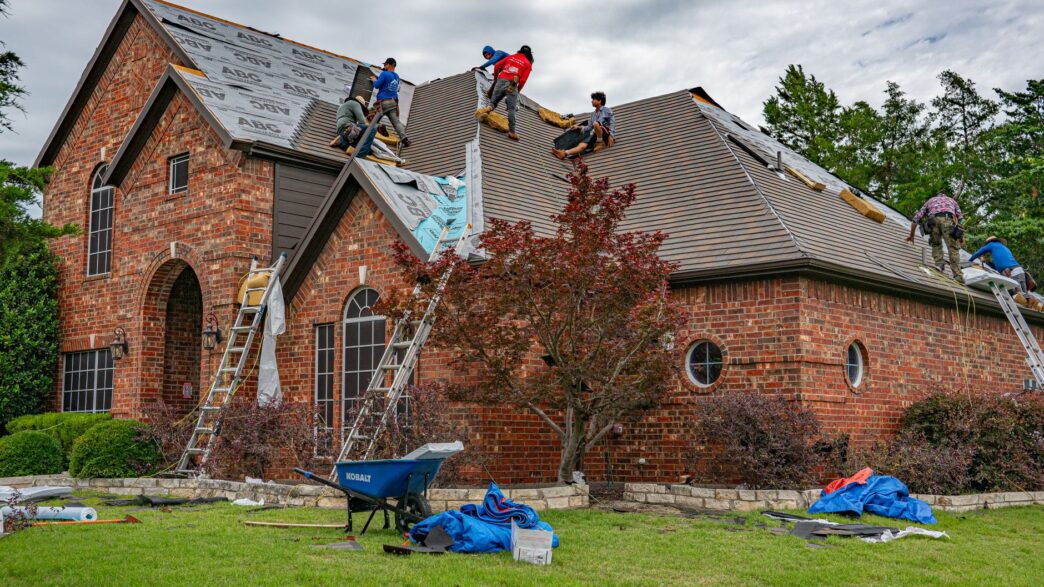
American Family has a form on file with the Nevada Division of Insurance called a Roof Surface Payment Schedule. It is a table. Roof ages down one side, roofing materials across the top, and in the cells the percentage of replacement cost the company will pay. For standard composition shingles, the most common roof in the country, the number at age 15 is 40%. At age 19 it hits 25% and stays there, described in the form as “payable for 19 years or over.”
That is roof actual cash value in practice. If the endorsement is attached to your policy, a hailstorm that destroys a 19-year-old shingle roof produces a check for a quarter of what a new roof costs, minus your deductible. Most homeowners find out they have it by filing a claim.
Roof actual cash value pays once, and replacement cost pays twice
The distinction everyone blurs starts with how a normal replacement cost claim gets paid. The Texas Department of Insurance describes it cleanly in its home insurance guide: “If you have a replacement cost policy, most companies pay with two checks. You’ll get the first check after the adjuster has looked at your damage. This check will be for the estimated cost of repairs, minus depreciation and your deductible.” The second check, the withheld depreciation, arrives “after it gets the bill for the finished job.”
That withheld amount is called recoverable depreciation, or the holdback. It is yours, conditionally. Do the work, send the invoice, get the rest.
Under a straight actual cash value settlement or a roof payment schedule, the depreciation is not withheld pending repair. It is not owed at all. There is no second check to recover because there is no holdback, just a single payment and the end of the file.
Here is why this catches people. On both kinds of claim, the first check looks small. A homeowner with proper replacement cost coverage and a homeowner with a roof schedule both open an envelope containing a fraction of what the roof costs. They cannot tell which situation they are in from the amount. The tell is the endorsement page, not the check. Iowa’s Insurance Division put the consequence in one sentence in a 2024 consumer alert: actual cash value roof coverage is cheaper, “but a claim payment will not replace the roof.”
The arithmetic
Zonda’s 2025 Cost vs. Value Report, the 38th annual edition, puts the national average cost of an asphalt shingle roof replacement at $31,871. That spec is a substantial roof, 30 squares with new underlayment, drip edge and flashing around two skylights, so treat it as the upper-middle case rather than a small ranch house.
Take that roof at 15 years old, destroyed by hail, with a $3,000 deductible.
On replacement cost coverage, the insurer owes $31,871 and you pay the $3,000 deductible. Your out of pocket is $3,000. The money arrives in two pieces, but it all arrives.
On American Family’s schedule at 40%, the insurer owes 40% of $31,871, which is $12,748. Subtract the $3,000 deductible and the check is $9,748. Your out of pocket is $22,123.
The difference is $19,123, and it is precisely the holdback that no longer exists.
Push the roof to 25 years and the Allstate roof surfaces endorsement, which declines composition shingles three percentage points a year, floors at 25%. A quarter of $31,871 is $7,968, less a $3,000 deductible leaves $4,968, against a $31,871 bill. At that point the insurance is paying for roughly one sixth of the roof.
Two details in the forms that make this worse than the headline percentage. Both the American Family and Allstate forms pay the smallest of several amounts, not the schedule amount. Allstate’s language is “the smallest of the following amounts,” listing the repair cost or the schedule figure. American Family lists five candidates and pays “the least.” The schedule is a ceiling, not a floor.
And the schedule applies on top of your deductible, not instead of it. Allstate’s endorsement says its provisions apply “in addition to the applicable deductible.” If you also carry a percentage wind and hail deductible, which is common in hail country, you take two independent haircuts. One percent of a $400,000 dwelling limit is a $4,000 deductible before the schedule percentage has done anything.
This got easier for insurers in March
For years, the practical brake on all of this was your mortgage. Fannie Mae and Freddie Mac required property insurance on a replacement cost basis, and that requirement flowed through to anyone with a conforming loan.
On March 18, 2026, Fannie Mae issued Lender Letter LL-2026-03, which reads: “We are also retiring the requirement to insure roofs on a replacement cost basis. The property insurance policy must provide coverage on a replacement cost basis, with the exception of roofs.” A note in the same document makes it explicit: “Roofs must be insured, but do not have to be insured on a replacement cost basis.” Freddie Mac made the matching change. The Federal Housing Finance Agency announced it as a cost-reduction measure, effective immediately for one-to-four-unit properties.
Read that carefully, because it cuts both ways. If you are shopping for cheaper coverage, an ACV roof is now an option your lender will accept, and it will genuinely lower your premium. If you are not paying attention at renewal, the one institutional party who used to insist on replacement cost for your roof has stopped insisting.
The loss pressure behind all of this is not subtle. Wind and hail caused 42.5% of all homeowners insurance claims in 2023, and about 2.8% of insured homes, roughly one in 35, filed a wind or hail claim in a typical year over 2018 through 2022. Insured losses from severe convective storms in the United States topped $50 billion for the third consecutive year in 2025.
How many policies have this? Nobody knows
I want to be straight about a gap in the public record. There is no credible count of how many insurers or states use ACV roof or roof-schedule endorsements. Two figures circulate online, one claiming 70% of major carriers enforce a roof age threshold and another claiming 85% of Oklahoma carriers use these schedules. Neither traces to an original study, a filing or a regulator. Do not believe either, including when you see them repeated confidently.
What is verifiable is that regulators have been tracking this for a long time. The Texas Statistical Plan for Residential Risks requires every insurer to code, for every policy, whether an actual cash value roof endorsement is attached, in a field called ROOFACV, along with separate fields reporting the difference between actual cash value and replacement cost. That reporting requirement has been mandatory since July 1, 1998. The practice is decades old. What changed in 2026 is the mortgage backstop.
What to do this week
Find your declarations page and the list of attached endorsements, which is usually a page of form numbers most people skip. You are hunting for anything with “roof” in the title: roof surfaces endorsement, roof payment schedule, roof surface actual cash value, windstorm or hail loss to roof surfacing. Form numbers to look for include the ISO roof surfacing form, Allstate’s AVP247, and American Family’s HO 88 02 01 14.
If you find one, three questions for your agent. What percentage would the schedule pay on a roof of my roof’s current age and material. What would replacement cost coverage for the roof add to my premium. And does my policy also carry a percentage wind and hail deductible on top of the schedule.
Then go find out how old your roof actually is. The closing documents from when you bought the house, a permit record with the county, or the previous owner’s disclosure will tell you. On the composition-shingle schedules above, every year of roof age costs you three or four percentage points of coverage, so the difference between believing your roof is 12 years old and learning it is 17 is somewhere around $6,000 on a claim.
One thing worth knowing if you decide the cheaper coverage is fine: on American Family’s form, the schedule “does not apply when we determine that your dwelling or other structure is a total loss.” The haircut is for roof claims, not for losing the house.
And if you live in Louisiana, your policy is required to carry a disclosure in bold type no smaller than 14 point, at the front of the policy, explaining the distinction between replacement cost and actual cash value and the use of depreciation. It is the only state I found that mandates the warning up front. Everywhere else, roof actual cash value is something you have to go looking for, in a list of form numbers written to be skipped, and the cheapest hour you will spend this month is the one where you find out whether it is there. Our guide to cutting your homeowners premium covers the savings that do not cost you coverage, and whether a home warranty is worth it applies the same kind of math to a different product.