









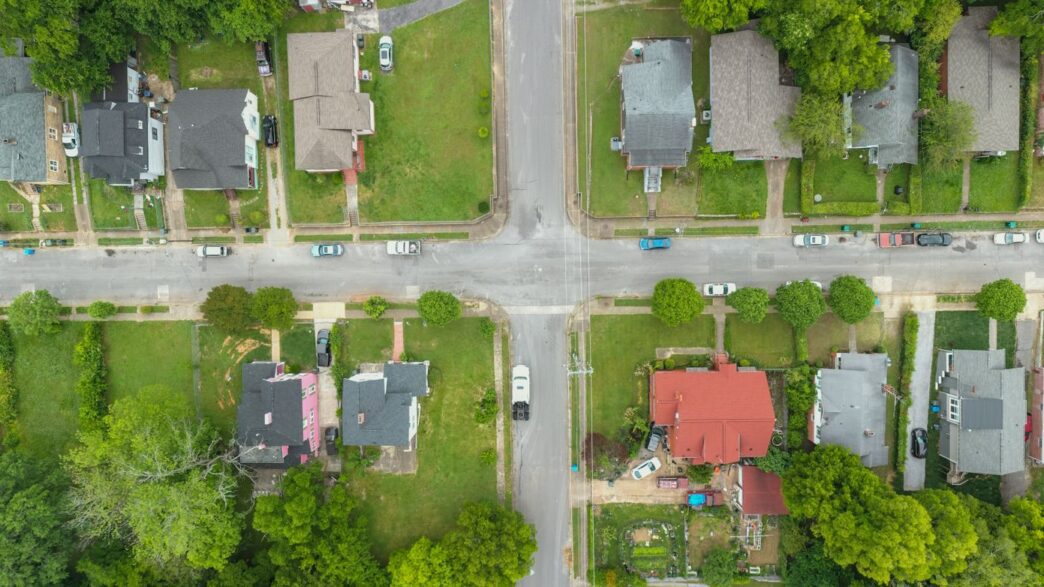
In Marion County, Indiana, 7,744 homeowners filed a property tax appeal in 2024. About 3,100 of them walked away with a lower assessed value. That is a 40 percent hit rate on a form that in most places costs nothing to file. The number that should bother you is the other one from that same WISH-TV I-Team investigation: only two to three percent of Marion County homeowners filed anything at all.
Good odds, almost no players. Some of that is the usual inertia about mail from the county. The bigger reason is that the standard advice sets people up to fail. Nearly every guide tells you to prove your house is worth less than the county says it is, and in a market where prices went up, that argument dies on contact. The appeal that actually wins is a different one: your house is assessed higher than the houses around it. Those are not the same claim, and the second one is far easier to prove.
Your assessment is a guess, and the guesses miss in a predictable direction
No assessor walked through your kitchen. County offices value tens of thousands of properties at once using statistical models fed by square footage, lot size, year built, and whatever sales happened nearby. It is a reasonable way to do an impossible job, and it produces errors.
The errors are not random. Christopher Berry, who runs the property tax research program at the University of Chicago’s Harris School, examined assessments across thousands of counties for his 2021 paper “Reassessing the Property Tax.” Homes in the bottom tenth of the price range were assessed at a ratio, relative to what they actually sold for, roughly twice as high as homes in the top tenth. In Detroit in 2017, the average home in the bottom decile carried an assessment around three times its real market value.
Sit with that for a second. The cheaper your house is relative to the county’s mix, the likelier the model overshot on you specifically. And the households most likely to be carrying an inflated assessment are the least likely to have a tax attorney on retainer, which is roughly the whole problem.
The advice you find first only works in a falling market
Search “how to appeal property taxes” and the first page of results converges on one recipe: pull three or four recent comparable sales, show the county your home would not fetch what they claim, attach photos of the cracked foundation and the roof you have been putting off.
That recipe was written for 2009. It works when values are dropping, and values are not dropping. ATTOM’s 2025 property tax analysis, released in April 2026, found $396.8 billion levied on 89.6 million single-family homes, up 3.7 percent from the prior year, with the average bill rising 3 percent to $4,427. The national effective tax rate climbed to 0.9 percent, its highest since 2020.
So a homeowner reads the guide, pulls comparable sales, discovers the sales support the assessor, and closes the tab. The appeal window passes. That is the most common way a property tax appeal is lost: it never gets filed, because the only argument the homeowner knew about did not apply.
The property tax appeal that wins compares you to your neighbors, not to buyers
There is a second ground for appeal that almost no consumer article mentions, and it does not require your home to have lost a dollar of value. It is usually called uniformity, or equal and uniform treatment, and the claim is simple. Even if the county’s number for your house is defensible in isolation, you are being assessed at a higher fraction of value than comparable properties on your street. Tax law generally treats that as its own injury.
Texas writes the standard into statute. Under Section 42.26 of the Texas Tax Code, relief is required if your appraisal ratio exceeds, by at least 10 percent, the median level of appraisal for a reasonable and representative sample of comparable properties. Win, and your value gets reset to that median. Other states express it differently, and some bury it under “equity” or “lack of uniformity” on the protest form, but the concept travels.
Uniformity runs on assessed values rather than sale prices, and that is what makes it the better argument in 2026. Assessed values for every property in your county sit in a public database you can search for free, usually straight from the assessor’s website, and there are always enough of them. You do not need three recent sales in a neighborhood where nothing has sold since 2023. You need twenty similar houses, their assessed value per square foot, and a calculator. If your number sits well above the median of that group, you have a case, and you built it in an afternoon.
What a ten percent reduction is worth in dollars
Ten percent sounds like a rounding error until you attach it to a bill. ATTOM put the average single-family home at an estimated $494,231 in value paying $4,427 in tax, an effective rate of about 0.9 percent. Knock 10 percent off the assessed value and you have removed $49,423 from the taxable base. At 0.9 percent, that is roughly $445 back in year one.
Then it repeats. A reduced value normally carries forward as the starting point for the next cycle rather than snapping back, so three years before the next full reassessment is somewhere near $1,300 for one filing. Higher-tax states multiply that hard. New Jersey’s average bill was $10,499 and Connecticut’s was $8,901, against $1,081 in West Virginia. On a New Jersey bill, the same 10 percent reduction is over $1,000 a year.
Compare that to the effort. Most first-level appeals are free, most start as an informal review with the assessor rather than a hearing, and the evidence is a spreadsheet of your neighbors’ public assessments. If you have ever spent an evening comparing homeowners insurance quotes, this is the same work for similar money. It also stacks with the other fixed costs of owning: lowering your homeowners insurance premium and weatherizing before winter both hit the same monthly escrow payment from different angles.
The deadline will beat you before the assessor does
Property tax appeal deadlines are mostly rolling, which means the clock starts when the county mails your assessment notice, not on some date you can look up in January. Thirty to forty-five days is typical. Notices go out in waves depending on where you live, and late summer into fall is one of the heavier windows.
Go find your most recent notice of assessment right now, before you do anything else. The deadline is printed on it, usually in small type near the appeal instructions. If you threw it out, the assessor’s website will list the current window. In most jurisdictions you can file to preserve your right first and submit evidence later, which means the correct move today is filing, not researching.
Marion County’s assessor told reporters the median assessed value there rose more than 25 percent over four years. Yours probably did something similar, and nobody at the county is going to call and ask whether that seems fair to you. The one homeowner in forty who files a property tax appeal is not smarter than the other thirty-nine. They opened the envelope and did the comparison.