







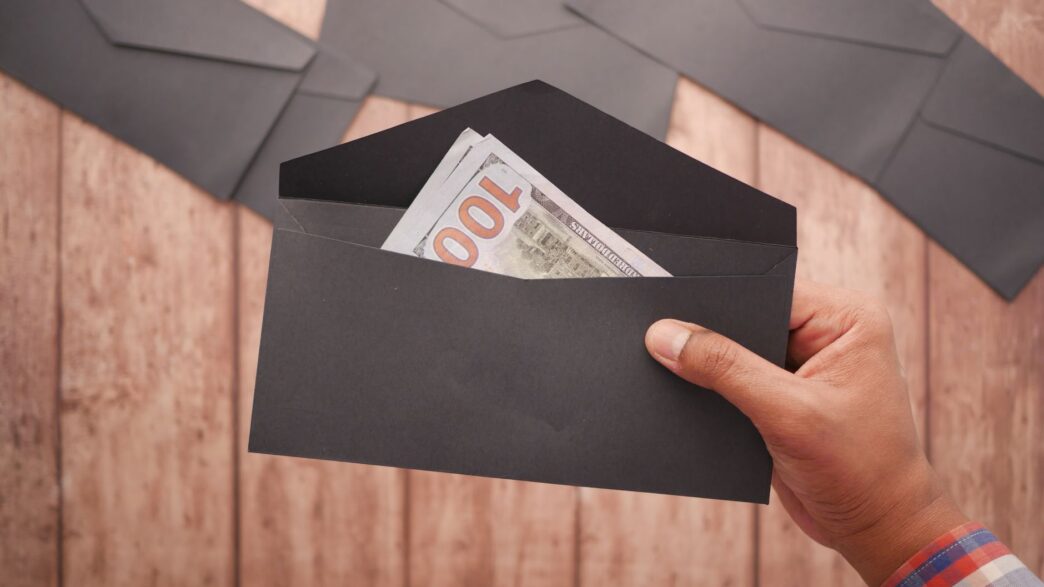
Deloitte’s 2026 holiday survey, released October 15, says the average shopper plans to spend $1,654 this season, up 4% from last year. That number is a plan. December has a way of turning plans into suggestions, which is why holiday cash stuffing shows up in every budgeting feed right about now. My take is narrower than what you’ll see there: stuffing your whole holiday budget into envelopes costs you real money, and stuffing exactly one of them, the gift envelope, is where cash earns its keep.
Most guides to the cash envelope system treat it as all or nothing. You withdraw your whole budget, label a dozen envelopes, and live out of them. That works for some people. For a 30-something who already pays most things with a card, it quietly gives up two things: card rewards, and the free fraud protection you get when a card number is stolen instead of an envelope.
Cash makes you spend less, and the research is blunt about it
The reason cash stuffing works at all is that handing over bills hurts more than tapping a card, and researchers have put a number on it. In 2001, MIT professors Drazen Prelec and Duncan Simester ran a sealed-bid auction for Boston Celtics tickets, published in Marketing Letters under the title “Always Leave Home Without It.” Half the bidders were told they’d pay by credit card, half in cash. The card group’s average bid came out nearly double the cash group’s for the same seats.
You don’t have to believe you’d spend twice as much to take the point. Even a modest version of that effect, applied to the part of your budget where you’re making emotional, one-off purchases, is worth a lot more than the 2% your card pays you back.
And most of us have drifted far from cash. Pew Research Center reported this fall that 42% of Americans don’t use cash for any purchases in a typical week, up from 24% in 2015. Cash fell from 33% of all payments in 2015 to 14% in 2025. When the default is a card, every purchase runs without that small sting.
Full cash stuffing has a price tag most guides skip
Say you normally pay with a flat 2% card like the Wells Fargo Active Cash. Move Deloitte’s full $1,654 average into envelopes and you give up $33.08 in cash back ($1,654 times 0.02). Thirty-three dollars won’t wreck anyone’s December. It stings more when you realize most of it comes from spending that cash wouldn’t have changed anyway.
Then there’s getting the cash. If you bank at Chase and grab it from a non-Chase ATM, Chase charges $3 per withdrawal, and the ATM owner adds its own surcharge on top. Four trips to refill envelopes over the season is $12 in Chase fees alone before the other bank takes its cut. If you go the cash route, pull it from your own bank’s ATMs or get cash back at the grocery checkout. We broke down the free ways to get cash in our guide to cutting ATM fees to zero.
The bigger cost is that cash stuffing groceries, gas, and holiday travel doesn’t buy you much discipline. You were going to buy the turkey and fill the tank regardless. Paying with bills doesn’t change how much gas the car holds. Those categories just lose their rewards and gain the hassle of keeping track of physical money.
The holiday gift envelope is where cash pays for itself
Gifts are the opposite. Every gift is a judgment call with no natural ceiling. A $40 sweater becomes a $65 sweater because the nicer one is right there. You add a stocking stuffer for your coworker. You buy a backup gift “just in case.” Card spending makes each of those choices feel free, and the Prelec and Simester research says that feeling shows up in the dollar amount.
So run the break-even math on a holiday gift budget. Deloitte’s survey puts planned spending on retail goods at $988 per shopper this year. Say that’s your gift budget. If you put it on a 2% card, you earn $19.76 back. If you pay in cash, you lose that $19.76. Cash wins the moment the card would have nudged you to spend more than 2% over budget, which is $19.76 on $988.
Two percent is a very low bar. If the card pushes you just 10% over, which is mild next to a study where card bidders nearly doubled their offers, you’d spend $1,086.80 instead of $988. That’s $98.80 extra. Subtract the $19.76 in rewards you gave up by switching to cash, and the envelope leaves you $79.04 ahead. At 20% over budget, which isn’t hard to hit when you’re shopping for ten people, the envelope comes out $177.84 ahead ($197.60 in avoided overspending minus $19.76).
Run the same numbers on groceries and the case collapses. A family’s December grocery bill has a floor (people need to eat) and not much of a ceiling for impulse, so the envelope saves you little while the 2% you give up is guaranteed. Keep the card there.
One envelope also fixes the January card bill
Cash has one more advantage that matters this time of year: it can’t follow you into January. A gift bought with an envelope is paid for the day you buy it. A gift bought on a card shows up as a statement balance in the new year, right when the holiday glow wears off. Keeping the gift budget in cash means the one category most likely to run over is also the one that can’t turn into a balance you carry.
The rest of your budget stays on the card, where it belongs. Pay the statement in full and you get the rewards, the fraud protection, and the convenience on everything that was never at risk of running away from you.
How to set up your holiday cash stuffing envelope this week
Start with a real number. Write down everyone you’re buying for and a dollar amount next to each name, then add them up. That total is your envelope. A number you wrote down name by name is much harder to fudge than one you picked because it sounded reasonable. If you want a framework for assigning every dollar of the season, our zero-based budgeting guide walks through it.
Next, get the cash for free. Use your own bank’s ATM or ask for cash back at a store checkout. One withdrawal for the whole envelope means you pay at most one fee if you slip up. Keep that envelope at home, not in your wallet, and take out only what you need for the day’s shopping trip. The Federal Reserve’s 2026 Diary of Consumer Payment Choice found consumers carry an average of $69 on them, and that’s about the right amount to have in your pocket at the mall. Leaving the full $988 at home means a lost wallet doesn’t wipe out your gift budget.
Online gifts are the hard part, since you can’t hand Amazon a twenty. The workaround: when you order online with a card, take the same amount out of the envelope that day and put it toward your card payment. The envelope still shrinks in real time, which is the whole point.
If you tried a full cash stuffing system before and gave up because it was too much to manage, a single envelope is far easier to stick with. Our original guide to cash stuffing covers the full method, but you don’t need twelve envelopes to get the benefit. You need one, aimed at the category where your judgment slips. For most of us in December, that’s gifts. Stuff that one, keep the card for the rest, and holiday cash stuffing pays you back in January instead of costing you.
Sources
- Deloitte, “2026 Holiday Retail Survey” press release (October 15, 2026): www.deloitte.com
- Pew Research Center, “From cash to credit: How Americans’ payment methods have changed in the past decade” (September 30, 2026): www.pewresearch.org
- Federal Reserve Financial Services, 2026 Diary of Consumer Payment Choice: www.frbservices.org
- Chase, Total Checking fee schedule: chase.com
- Prelec, D. and Simester, D., “Always Leave Home Without It: A Further Investigation of the Credit-Card Effect on Willingness to Pay,” Marketing Letters (2001)