







Everyone who writes about dwelling coverage tells you to insure to 100% of rebuild cost and to watch out for underinsurance in a total loss. That framing lets most homeowners off the hook, because a total loss feels remote and a kitchen fire does not.
The framing is wrong. If your dwelling coverage amount falls below a threshold in your policy, typically 80% of replacement cost, the insurance-to-value clause reduces every claim proportionally. Not just the catastrophic one. The $60,000 fire too, even though your policy limit is nowhere near exhausted.
Here is the formula, which almost no consumer article prints: your payout equals the amount of insurance you carry, divided by the amount you were required to carry, multiplied by the loss. Fall short and that first fraction is less than one, and it scales down everything.
The arithmetic on a partial loss
Take a house insured for $400,000 six years ago, when the insurer’s cost estimator said that was the rebuild number.
Construction costs have moved since. Verisk’s 360Value quarterly reconstruction cost analysis for the third quarter of 2025 found residential reconstruction costs rose 4.0% nationally from July 2024 to July 2025, with labor up 5.0% and materials up 2.8%. That was actually a slowdown from 5.2% the prior year. Compound something in that range across six years and a rebuild estimate plausibly lags reality by 20% to 25%.
So call the true rebuild cost today $500,000. Your required limit at an 80% threshold is $400,000. If your limit is still exactly $400,000 you are fine, at the line.
Now suppose your limit sits at $380,000, which is what happens when inflation guard has been nudging a stale baseline rather than re-running the estimate. You are at 76% of replacement cost, below the threshold.
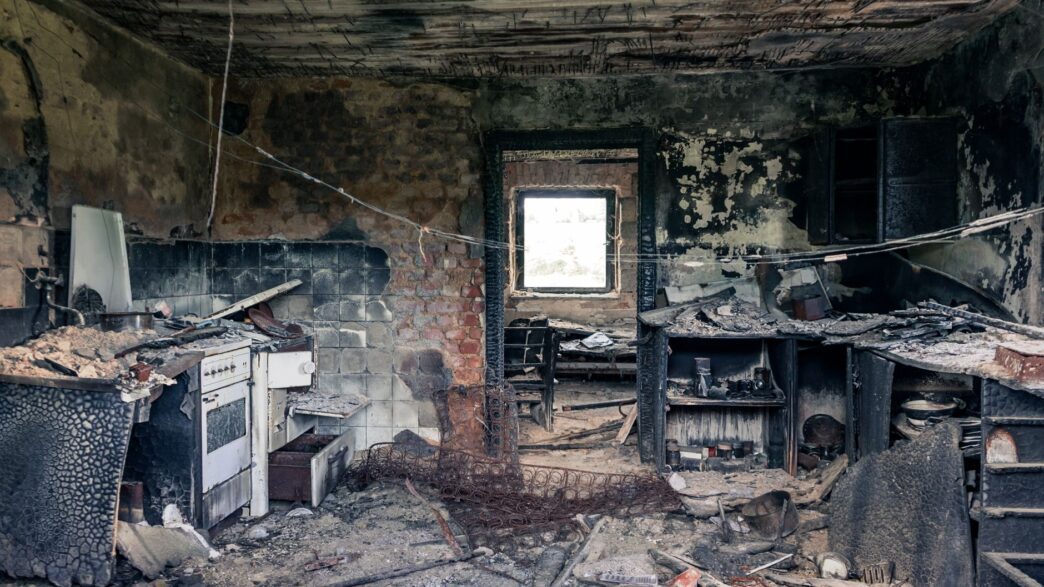
A $60,000 kitchen fire now pays: $380,000 divided by $400,000, times $60,000, which is $57,000. You are $3,000 short before your deductible comes out at all. On a loss that used 15% of your policy limit.
Scale that up and it gets uglier. The same shortfall on a $200,000 partial loss costs you $10,000. The penalty is a percentage, so it grows with every claim you file, and it applies to claims you would never have thought of as underinsurance events.
Why your dwelling coverage amount drifts out of date
Two mechanisms, and neither is anybody acting in bad faith.
Your original limit came from a replacement cost estimator run at the time you bought the policy. Those tools are reasonable snapshots and they go stale.
Then inflation guard takes over, raising your dwelling limit each renewal by a fixed index percentage. The problem is that it applies a smoothed national or regional average to the original baseline rather than re-running the underlying estimate. Verisk’s own data shows reconstruction cost growth varying from roughly 1% to 8.6% depending on the state, which a flat percentage cannot track. And inflation guard captures nothing about localized demand surge, the labor and materials spike that follows a regional disaster, which is precisely when a lot of people need to rebuild.
So the drift is structural. Your limit rises steadily while actual costs rise unevenly and faster.
The two endorsements that fix it
Extended replacement cost adds a percentage cushion above your dwelling limit, commonly 25% with a market range of roughly 10% to 50%. On a $400,000 limit with 25% extended replacement cost, the insurer will go to $500,000 if that is what the rebuild costs. Amica publishes extended replacement cost up to 130% of the dwelling limit on one of its policy tiers.
Guaranteed replacement cost has no percentage cap. It pays what the rebuild costs, full stop. It is also increasingly restricted. Erie Insurance writes most new homeowners policies with guaranteed replacement cost as the standard settlement option in twelve states plus the District of Columbia, and substitutes an enhanced replacement cost version elsewhere. That state-by-state split is the shape of the market: available where the insurer likes the risk, unavailable where it does not.
The relevant point for the coinsurance trap is that extended replacement cost also gives you headroom above the threshold, which protects your partial losses as well as your total ones.
How many people have either? A Policygenius survey in 2023 found 68% of homeowners may lack guaranteed replacement cost and roughly 80% may lack extended replacement cost.
How bad the underinsurance problem is
I want to be careful here, because the most-quoted figure in this space is hard to verify.
You will see it stated that about 60% of American homes are underinsured by an average of 20%, attributed to CoreLogic. That number is repeated widely, including by consumer advocates, but I could not locate the primary report behind it. Treat it as commonly attributed rather than established.
What is better documented is the California wildfire experience. United Policyholders, the consumer advocacy organization that has worked with disaster survivors for decades, has published findings that two thirds of homeowners were underinsured for wildfire loss. A 2025 investigation of Northern California wildfire claims reported that at a $250 per square foot rebuild assumption 36% of policies were underinsured, and at $350 per square foot the figure was 67%, and that regulators found several large carriers had used a reconstruction cost tool in ways that produced systematic underinsurance. I could not read that investigation in full, so verify those specific percentages before repeating them, but the direction is consistent with everything else here.
There is no reliable national rebuild cost per square foot, incidentally. Aggregator sites quote anything from $100 to $500 with no traceable methodology. Anyone who gives you one number for the whole country is guessing.
What to do this week
Find your dwelling coverage amount on the declarations page, then get an independent read on what your house would actually cost to rebuild. Two free ways: ask a local general contractor what they are charging per square foot for new construction in your area right now and multiply, or ask your agent to re-run the carrier’s replacement cost estimator rather than relying on the inflation-guard number.
Then do one division. Your dwelling limit divided by that rebuild figure. If the answer is below 0.80, your partial losses are already being discounted and you would not know until you filed one.
Then ask your agent three questions: whether your policy contains a coinsurance or insurance-to-value clause and at what percentage, what extended replacement cost costs and at what percentage, and whether guaranteed replacement cost is available to you at all in your state.
The thing to understand about your dwelling coverage amount is that it is not a ceiling you hope never to reach. It is a divisor applied to everything, and it has been quietly drifting out of date since the day you bought the policy. Our guide to ordinance or law coverage covers the code upgrades that make a rebuild cost more than the estimator assumed, and percentage hurricane deductibles are calculated off this same dwelling limit.