









Go look up what your car insurance deductible actually saves you and you will find the same paragraph on every page. Higher deductible, lower premium, more out of pocket. Lower deductible, higher premium, less out of pocket. Pick what you are comfortable with. That is it. State Farm, Travelers and Progressive all rank on the front page for this question and not one of them prints a savings figure or a claim probability, which means the single calculation the decision requires is missing from all three.
So here it is. Moving from a $500 deductible to $1,000 saves the average American driver about $188 a year, and the collision claim you are buying protection against happens roughly once every 24 years. Run those two numbers against each other and the answer stops being a matter of comfort.
What raising your car insurance deductible actually saves
Quadrant Information Services rate data, compiled in April 2026 for a 40-year-old driver carrying full coverage at 100/300/100 limits, puts the national average full-coverage premium at $1,895 a year with a $500 deductible and $1,707 with a $1,000 deductible. That is the $188. Going the other direction, down to $250, costs $2,063, so the cheap deductible is a $356 annual purchase compared with the $1,000 tier.
The spread varies enormously by state, and this is where the averages mislead. South Dakota drivers save $424 a year on that same step, Wyoming $328, Montana $311. Florida drivers save $115 and New Jersey drivers $109. If you live in a state at the bottom of that range, everything below still works but the margin is thinner, so pull your own renewal quote at both deductibles rather than trusting a national figure.
One warning about a number you will run into. The Insurance Information Institute’s own cost-cutting brochure says going to a $1,000 deductible “can save you 40 percent or more.” That percentage is measured from a $200 baseline, not $500, and it applies only to the collision and comprehensive portion of your premium, not the whole bill. Collision and comprehensive together are roughly half of a full-coverage premium. Anyone telling you to expect 40% off your total is misreading that line by about three times.
The claim you are insuring against happens once every 24 years
This is the term the search results leave out entirely, and without it the whole question is unanswerable.
ISO, the Verisk unit that compiles industry claims data, counted 4.16 collision claims per 100 insured car-years in 2024, along with 3.95 comprehensive claims. Collision alone works out to one claim per vehicle roughly every 24 years. Add comprehensive and you are at 8.11 physical damage claims per 100 car-years, or one claim about every 12 years.
Twelve years. That is the frequency your low deductible is priced against.
The average collision claim ISO recorded in 2024 was $5,489, which is worth knowing because it tells you the deductible is rarely the binding constraint on a real claim. On a $5,489 repair, the difference between a $500 and a $1,000 deductible is the difference between the insurer paying $4,989 and $4,489. You are paying $188 every single year to shift $500 once every 12 to 24 years.
The breakeven is 4.6 times further away than your actual risk
Now the arithmetic, which takes one line.
Raising the deductible by $500 costs you $500 extra on the claims you do file, and saves $188 on every year you do not. The two break even when you file 0.376 claims a year, because $188 divided by $500 is 0.376. That is 37.6 claims per 100 car-years.
The actual national figure is 8.11 per 100 car-years. You would have to crash and file 4.6 times more often than the average insured vehicle before the $500 deductible starts paying for itself.
Put the same math in dollars. At 8.11 claims per 100 car-years, the expected annual cost of carrying the extra $500 of exposure is about $40.55, because 0.0811 times $500 is $40.55. You are paying $188 a year to avoid an expected $40.55. The net expected gain from raising the deductible is around $147 a year, and over one average 24-year collision interval the accumulated savings come to roughly $4,519, which is nine times the $500 you were protecting.
Two and two thirds years of savings fully funds the extra exposure. After that you are ahead on any reasonable view of the odds.
Where this actually goes wrong
The math is lopsided, so the honest case against raising your deductible has nothing to do with probability. It has to do with cash.
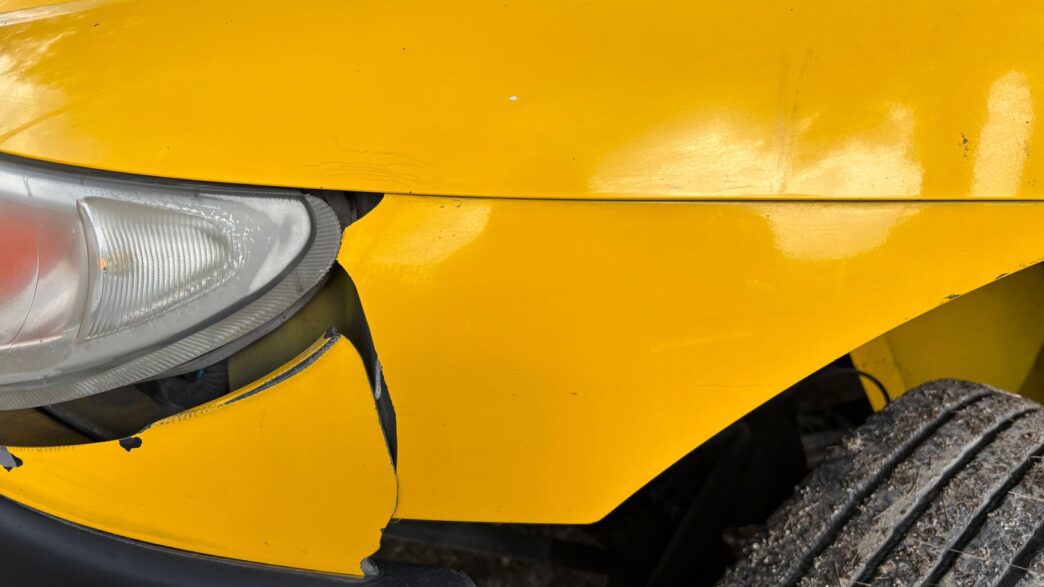
The risk is not that the expected value fails. It is that the extra $500 is not in your account on the Tuesday your bumper is in three pieces, and you end up on a payment plan with the body shop or driving a damaged car for two months. If you cannot write a $1,000 check today without moving money around, the low deductible is buying you liquidity, and liquidity is a legitimate thing to buy. The correct sequence is to bank the $188 somewhere you can reach it, let it build for three years, and then raise the deductible once the cash exists.
Three real complications worth checking before you call.
Newer cars break the averages. The Highway Loss Data Institute puts collision claim frequency for 2022 through 2024 model-year vehicles at 5.9 per 100 insured vehicle years with average severity of $10,267, roughly double the all-vehicle figure. A new car claims more often and costs more to fix, which moves the breakeven meaningfully against you. Still positive, but less lopsided.
Your deductible comes off a total loss too. J.D. Power’s 2025 auto claims study, based on 9,455 claimants, found total losses had risen to 27% of claims from 16% in 2022. On a totaled car, the deductible is subtracted from the settlement, so a higher deductible bites on exactly the claim where you most need the full check to go buy a replacement.
And if you already avoid filing small claims, a low deductible is money spent on an option you will never exercise. That same J.D. Power study found 7% of customers declined to file a claim at all out of fear of a rate increase. If that is you, you are paying the $500 deductible premium and then behaving like someone with a $2,500 deductible.
One thing I cannot tell you
There is no credible published figure for what the step from $1,000 to $2,500 saves. I went looking specifically and the number does not exist from any regulator, rate filing or named study. Every percentage in circulation traces back to an aggregator quoting another aggregator. Since collision and comprehensive are only about half your premium, there is a hard ceiling on what that step could possibly save, and it is smaller than the marketing implies. If a quote engine shows you a big drop at $2,500, take the actual dollar figure from your own renewal and run the same division above. Do not accept a percentage.
Also check whether your lender allows it. Auto loan and lease agreements frequently cap the collision deductible, which can make the higher tiers unavailable on a financed car regardless of what the math says.
What to do this week
Pull your renewal declarations page and find your current collision and comprehensive deductibles. Then ask your insurer, or run their online quote tool, for the same coverage at $1,000, and write down the dollar difference rather than the percentage. Divide $500 by that number. If the answer is under about four years, and you can cover $1,000 today, take the higher deductible and move the difference into savings automatically so the money is there when you need it.
One more move worth asking about. Allstate publishes a Deductible Rewards feature that cuts $100 off your collision deductible at enrollment and another $100 for each accident-free year, up to $500, and Progressive offers an equivalent disappearing deductible. A $1,000 deductible enrolled in one of those programs behaves like a $500 deductible after five clean years while staying priced nearer the $1,000 tier, which is the closest thing to having it both ways.
The premium environment has calmed down, which changes the urgency a little. Motor vehicle insurance ran up 17.4% in 2023 and 17.8% in 2024 before slowing to 6.0% in 2025 by the Bureau of Labor Statistics measure. The car insurance deductible decision is no longer a panic response to a spiking bill, just a quietly profitable adjustment most drivers never make. If you want the other half of the savings, our guide to shopping your auto policy covers switching carriers, and what your renewal increase is actually based on explains how to look up the filing behind it.