




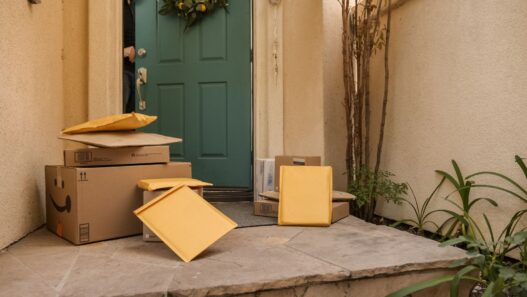



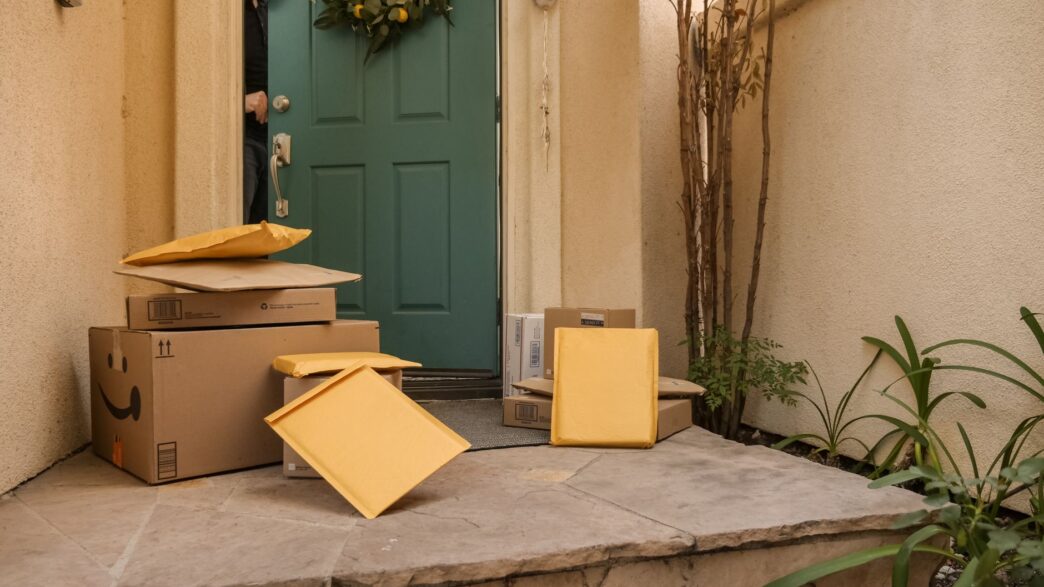
Porch pirates walked off with an estimated $7.7 billion in packages over the past year, according to a Security.org survey of 3,494 U.S. adults taken September 22 to 24, 2026. The average stolen box was worth $161. If one of yours vanishes between now and New Year’s, the stolen package refund you’re counting on probably won’t come from the places people check first. Your homeowners policy will almost certainly pay nothing. The carrier will point at its “delivered” scan and close the ticket. The money comes back through two doors: the store you bought from, and the card you paid with. So the useful work happens this week, before the first Black Friday box lands on your steps.
Your homeowners or renters policy is the wrong place to file
Every “what to do if your package is stolen” checklist tells you to check your insurance. Do the arithmetic before you pick up the phone. Say your homeowners or renters policy carries a $1,000 deductible. One stolen box worth the survey’s average of $161 gets you $161 minus $1,000, which is zero. Drop the deductible to $500 and picture a truly bad December: three boxes stolen at $161 each. That’s $483 in losses, still $17 short of the deductible, so the check is still zero.
And a claim that pays nothing isn’t free. Claims history can follow you to your next renewal, and a small theft claim is about the worst trade you can make with your insurer: all of the record, none of the money. Unless someone hauled off a new laptop and a TV in the same afternoon, leave your policy out of it.
The carrier’s “delivered” scan is where its responsibility ends
Most theft guides tell you to file a carrier claim and stop there. The U.S. Postal Service’s own claims rules in its Domestic Mail Manual have long listed loss that “occurred after delivery by the USPS” as nonpayable. Once the carrier scans your box as delivered, the Postal Service considers its job done. And with UPS and FedEx, the shipping contract usually belongs to the seller, so the claim is the seller’s to make, not yours.
That doesn’t mean skip the carrier. In the Security.org survey, 52% of recent theft victims reported it to the delivery company, and a report gives you a ticket number and a paper trail. Just don’t sit around waiting for a check from them. It isn’t coming.
The retailer is your fastest stolen package refund
The same survey found the most common move after a theft, made by 60% of recent victims, was contacting the store. That’s the right instinct. The retailer has a relationship with the carrier, it has an incentive to keep you buying, and it often sends a replacement just to close the ticket. If you bought from a third-party seller on Amazon, the A-to-z Guarantee is built for exactly the “it says delivered but I never got it” problem.
The way you ask decides how fast this goes. Give it a day first, because a lot of “stolen” boxes turn up on a neighbor’s porch or behind a planter. Then open a chat, paste the tracking number, attach a photo of your empty doorstep, and say plainly that tracking shows delivered and you never received it. Ask for a replacement or a refund to your original payment method. Store credit doesn’t count as a refund.
File a police report too, even though only 23% of victims in the survey did. You won’t get a detective on the case. You’ll get a report number, and that number is what turns a card benefit claim from “maybe” into “approved.”
Credit card purchase protection is the backstop that pays
If the retailer won’t budge, your card’s purchase protection is where the money is. Chase’s Freedom Unlimited, for example, covers theft of eligible purchases for up to 120 days after you buy, up to $500 per claim and $50,000 per account. Run the bad-December numbers again. Three stolen boxes worth $161 each is $483. Your homeowners policy pays $0 of that. Filed as three separate card claims, each well under the $500 cap, the card can reimburse the whole $483.
Two catches. First, debit cards rarely come with this benefit, so a box bought with a debit card has nothing behind it once the retailer says no. Second, these benefits have fine print. Chase’s summary lists stolen items as covered but doesn’t address porch theft specifically, so open your card’s Guide to Benefits tonight, search for the word “unattended,” and see what it says about items left outside. Five minutes now beats finding out after the claim is denied.
The move for this week: figure out which card in your wallet has purchase protection and make it the default payment method on Amazon, Target, Walmart, and wherever else you’ll do holiday shopping. If you can’t pay the full balance when the statement arrives, the interest eats the benefit, so this only works for people who pay in full.
Paying monthly to guard a $161 box rarely makes sense
After a theft it’s tempting to buy a camera plan out of pure irritation. Run the numbers first. In the Security.org survey, 4% of adults said they’d had a package stolen in the previous three months. Multiply that 4% by the $161 average and your expected loss over a holiday quarter is about $6.44. Spread over three months, that’s roughly $2.15 a month. Any monthly subscription costing more than that is, for the average household, more expensive than the theft it’s watching for. A camera also doesn’t bring your box back. It just records it leaving.
Averages hide a lot, of course. If your building leaves packages in an open lobby, or your porch faces a busy street, your odds are worse than 4%. The cheaper fix in that case is still free: send your orders to Amazon Hub lockers, UPS Access Point locations, or FedEx’s hold-at-location option, and pick them up on your way home. The survey found adults expect about 28 packages between October and December. You don’t need to reroute all of them. Reroute the ones worth more than a dinner out.
The same habit of routing boxes to a pickup point also helps with return fees, and if you’re mailing gifts yourself, our notes on holiday shipping costs cover the timing.
Your 20-minute setup before Black Friday
Black Friday is November 27, which gives you a few weeks to get ready. Tonight, read your card’s Guide to Benefits and confirm the purchase protection window and per-claim limit. Make that card the default at the stores you’ll actually use. Pick the locker or pickup point closest to your commute and save it as an address in your Amazon and carrier accounts. Turn on delivery notifications so a box isn’t sitting outside for six hours while you’re at work.
Then, if something does disappear, you already know the order: wait a day, contact the retailer with tracking and a photo, file the police report online, and submit the card claim well inside the window. A stolen package refund mostly comes down to having the right card on the order and knowing which door to knock on first. The insurance company isn’t one of them.