









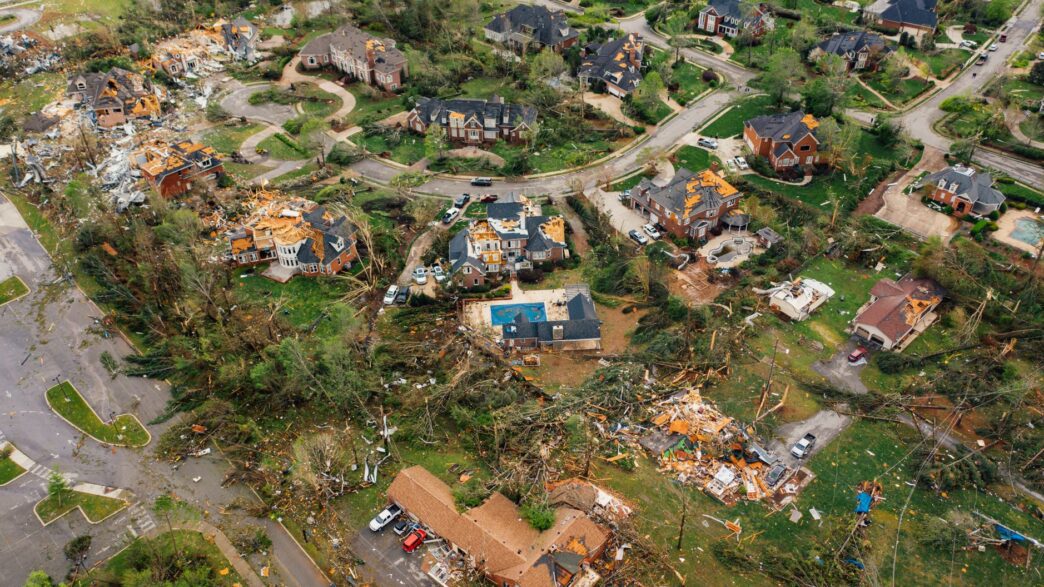
The Texas Department of Insurance publishes two versions of the same hail claim. Same $150,000 house, same $6,500 roof. The homeowner with a $500 flat deductible collects $6,000. The homeowner with a 5% deductible collects nothing, because 5% of $150,000 is $7,500 and the repair costs less than that.
Nobody’s house was damaged differently. One of them just had a percentage where the other had a dollar amount, and it turned a $6,000 check into a $0 check.
That is the whole problem with a hurricane deductible, and the reason it catches people is a single misreading: the percentage applies to your dwelling coverage limit, not to the size of your claim.
Your hurricane deductible, converted into real dollars
Take the tiers that regulators describe as common. Florida’s statute requires insurers to offer hurricane deductible options of $500, 2%, 5% or 10% of the dwelling limit. The NAIC describes the national range as running from 1% up to as high as 15%. Colorado’s Division of Insurance tells its residents the common tiers are 1%, 2% or 5%.
Here is what that does at a few coverage levels. At a $300,000 dwelling limit, 1% is $3,000, 2% is $6,000, 5% is $15,000. At $500,000, a 2% deductible is $10,000 and a 5% deductible is $25,000.
So the homeowner who has been assuming a $1,000 deductible because that is what the all-other-perils line says may be carrying a $10,000 deductible for the one peril most likely to damage the house.
Now set that against what a real wind claim costs. The average wind and hail claim in 2023 ran $14,747 in severity, with 2.80 claims per 100 insured house-years, according to ISO data compiled by the Insurance Information Institute. Wind and hail was the largest single cause of homeowners losses that year at 42.5%.
Put those two numbers together and the result is uncomfortable. Against a 5% deductible on a $300,000 dwelling limit, which is $15,000, the average wind and hail claim pays nothing. Against a $1,000 flat deductible, the same claim pays $13,747.
The deductible is triggered by a clock, not by your roof
This is the part almost no consumer article explains, and it decides whether the big number applies at all.
The trigger is not a wind speed reading at your property. It is a window of time defined by National Weather Service declarations, and it is usually statewide.
Florida spells it out in statute. The hurricane deductible applies from the moment a hurricane warning is issued for any part of Florida by the National Hurricane Center, and it keeps applying until 72 hours after the last hurricane watch or warning for any part of Florida ends. Any covered windstorm loss inside that window gets the hurricane deductible.
North Carolina’s named-storm deductible works similarly but with a shorter tail: it begins when an advisory, watch or warning for a named storm is issued for any part of the state and ends 24 hours after the last one terminates.
Read those carefully and the practical consequence is strange. Damage that happens on a calm day inside the window can get the big deductible. Identical damage a day outside the window gets your ordinary one.
It also matters which of three deductibles your policy actually carries, because they are not the same thing. A hurricane deductible applies only to a storm the National Hurricane Center has declared a hurricane. A named storm deductible is broader, covering tropical storms and depressions once they are named. A windstorm or wind and hail deductible is broadest of all, and applies to any wind or hail event whatsoever. As the NAIC puts it, if a tree falls on your roof on a windy day, the claim is subject to the wind deductible.
That last category is why this is not a coastal story. Colorado’s Division of Insurance issued a consumer advisory in May 2024, after hail hit Yuma, Wray and Akron, reminding Coloradans that many policies carry wind and hail deductibles set as a percentage of coverage, and that if damage estimates come in below the deductible, the insurer will not issue a payment. No hurricane, no coastline, same arithmetic.
Per storm or per season, and the credit you can lose
Nineteen states plus the District of Columbia had some form of hurricane or named-storm deductible in place as of June 2025, per the NAIC, and how often you pay it varies.
Florida runs an annual version for personal residential policies. The hurricane deductible applies on a calendar-year basis to all covered hurricane losses, so once you have satisfied it, later hurricane claims that year fall back to your ordinary deductible.
The state’s own worked example shows how the credit accrues. On a $200,000 dwelling limit with a 2% hurricane deductible, which is $4,000, and a $1,000 all-other-perils deductible: a first hurricane causing $2,000 of damage leaves you paying all of it, with $2,000 credited and $2,000 of deductible remaining. A second hurricane causing $5,000 has the remaining $2,000 subtracted, so the insurer pays $3,000, and the annual deductible is now met.
The trap is the fine print on that credit. It holds only while you stay with the same insurer or one in the same group. Switch carriers mid-season and the full hurricane deductible applies again to the next claim, with no credit for what you already absorbed.
Texas, by contrast, applies the deductible to each claim. The NAIC’s guidance is simply that your deductible “could be per event, per season, or per calendar year,” and to read the policy.
One piece of good news: the two deductibles are alternatives, not additions. Florida states it directly, that when a hurricane deductible is applied, no other deductible under the policy may be applied. A roof deductible cannot be layered onto a hurricane roof loss either.
Where to find your actual number
Florida requires the hurricane deductible to be listed on the policy as a dollar amount even when it is expressed as a percentage, which means Florida homeowners can read the real figure off the declarations page today. North Carolina’s Department of Insurance directs consumers to the same page, noting the deductible is typically a percentage of Coverage A or Coverage C and is shown there.
Two Florida provisions worth knowing if you are tempted by the cheapest premium. Because Inflation Guard raises your dwelling limit over time, it also raises a percentage deductible, and insurers must disclose on the declarations page when that can happen. And for dwellings insured under $500,000, a hurricane deductible above 10% requires you to handwrite or type and sign a statement beginning “I do not want the insurance on my home to pay for the first…” along with written approval from your mortgage holder. When a state makes you write the sentence out by hand, that is a signal.
What to do this week
Find your declarations page and look for three separate deductible lines rather than one: all other perils, and then anything labelled hurricane, named storm, windstorm or wind and hail. Convert any percentage into dollars by multiplying it against your Coverage A dwelling limit, not against your home’s market value and not against your mortgage balance.
Then ask your agent two questions. Which trigger your policy uses, and whether the deductible applies per event, per season or per calendar year. If you are in a state with an annual deductible and you were planning to switch carriers, ask what happens to the credit, because switching in August can cost you the deductible twice.
One last tip from Florida’s own consumer guidance that runs against instinct: file the claim even when the repair costs less than your hurricane deductible. You get nothing now, but the amount is credited toward the annual deductible for the next storm, and contractors routinely find damage once they are on the roof. Our guide to cutting your homeowners premium covers the savings that do not cost you coverage, and whether your roof is still insured at replacement cost is the other endorsement that quietly guts a wind claim.