







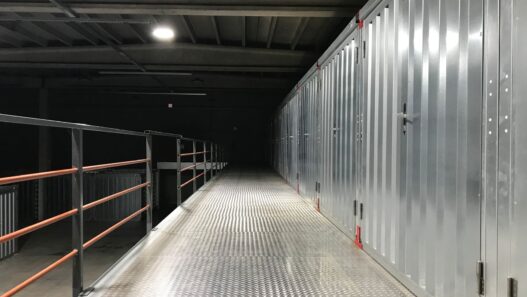
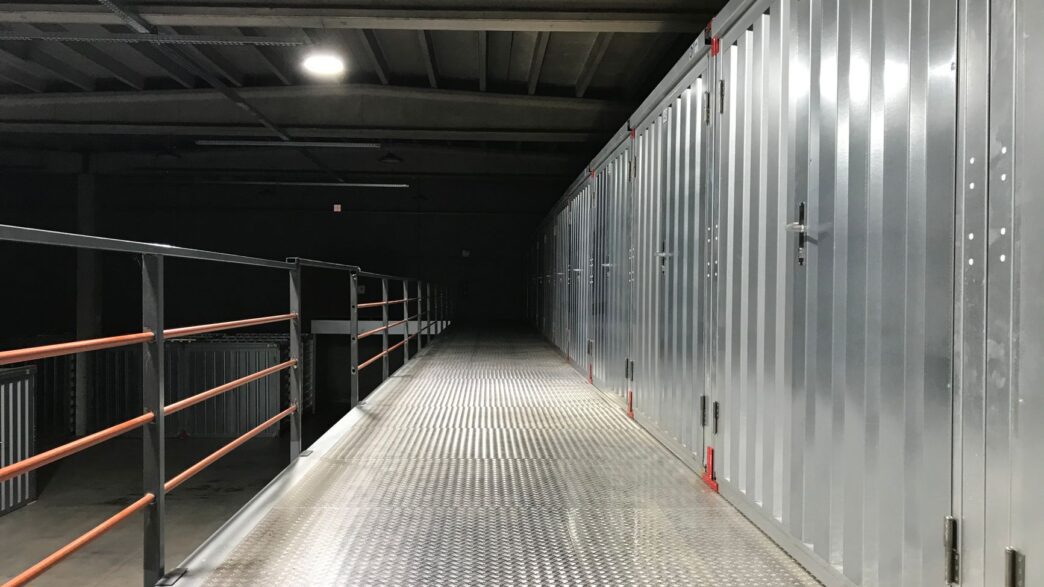
Public Storage told the SEC exactly how much more you pay than the person who rented the unit down the hall last month. In a filing dated March 2, 2026, covering the period through February 25, the company reported that customers moving in were signing at an average annual contract rent of $11.93 per square foot. Customers already in place were paying $22.13. Same building, same hallway, same buzzing fluorescent light. The second number is 85 percent higher than the first, and the space between them is the entire reason your storage unit rate increase showed up in your inbox.
The gap is not a secret. It gets published every quarter, in dollars, by the largest operator in the country. Almost nobody renting a unit has ever seen it, which is a shame, because a number the company publishes about itself is the strongest thing you can bring to a phone call.
The New Customer at Your Facility Is Paying About Half Your Rate
Run the arithmetic on a 10 by 10 unit, 100 square feet, the size most people end up with when they have a garage worth of stuff and no garage. At the move-in rate of $11.93 per square foot per year, that unit goes for $1,193 a year, about $99 a month. At the in-place rate of $22.13, the identical unit costs $2,213 a year, roughly $184 a month. The difference is $85 every month and $1,020 over a year, for the same concrete.
You did not get worse at negotiating. You got quiet. The industry has a name for what happened to you: the existing customer rate increase, or ECRI, a letter or email that raises the rent on somebody who has already moved in and is unlikely to move out over it. Rent goes up because moving a couch twice costs more than $85, and the operator knows it. Public Storage says so plainly in the same filing, in the definition of contract rent: rates are set at move-in and the company “adjusts them from time to time with notice.”
The first increase usually arrives three to six months after you sign, and then roughly every six to twelve months after that. Meanwhile the teaser rate that pulled you in gets recycled on the unit next to yours for the next customer. In that same February period, Public Storage handed out $9.2 million in promotional discounts against $36.9 million in new contract rent, which is a quarter of the front door revenue given away to keep the funnel full.
A Storage Unit Rate Increase Is Easier to Fight in 2026 Than It Was in 2023
Most advice on this tells you to call and ask nicely. Fine as far as it goes, and it skips the part that actually changes the manager’s answer, which is whether the building needs you.
Right now it does. Yardi Matrix, which tracks advertised rates across the country, put the national average asking rate at $16.47 per square foot in July 2026, down 1.5 percent from a year earlier, with year over year declines running through most of the year. A wave of new construction landed into soft demand, and storage demand follows moving, which follows home sales, which have been slow.
The squeeze shows up in the operator’s own reporting. Public Storage’s second quarter results, filed July 29, 2026, show same store revenue down 0.6 percent from a year earlier, realized rent per occupied square foot down 0.8 percent, and marketing spending up 6.3 percent. That is a company paying more to fill units at lower rates, which is the exact moment a customer who might leave becomes expensive.
Then there is the calendar, and the same filings size it for you. Public Storage’s occupancy averaged 92.5 percent in the second quarter, the heart of moving season, and sat at 91.7 percent back in late February. Under a point of swing sounds small until you remember it applies to 259 million square feet. Demand slides through the fall, so a manager looking at October has a good deal less appetite for losing a paying tenant than one turning people away in June.
Ten Minutes on the Phone, With Their Numbers in Front of You
None of that helps unless you make the call, so make it a short one and do the homework first. Pull up your facility’s own website and price the same size unit as a new customer, in an incognito window. Write that number down. Do the same for two competitors within a few miles. Then call the facility directly, not the corporate line, and ask for the manager.
The script is short. You have been a customer for however many months, you have never paid late, your rate is now $184, the same unit at this location is advertised online at $99, and two facilities nearby are at $110 and $120. You would rather not move, and you are asking to be put back on the current rate. If the first answer is no, ask what the manager can do, because managers usually hold authority to hold a rate or reverse an increase without escalating. A rate freeze is a win. A partial rollback is a win. Getting the increase reversed for six months and then having to call again is still a win, because that call is worth $85 a month.
Then get it in writing. Send a short email repeating what you agreed to and keep the reply, because the promised change does not always reach the next bill by itself.
When the Answer Is No, Read the Billing Cycle Before You Move
If the manager holds firm, two things are worth checking before you sign somewhere else.
The first is your billing cycle. Some operators bill every 28 days instead of monthly, which Slate documented in January 2025 as a quietly spreading practice. A year has 52 weeks, so four week billing produces 13 payments a year instead of 12. On a $184 unit that is an extra $184 you never agreed to in any conversation, hiding in the definition of a month. Compare quotes on annual cost, not monthly rate.
The second is that regulators have started treating the bait and switch as a legal problem rather than a pricing strategy. New York City’s Department of Consumer and Worker Protection sued Extra Space Storage in February 2026 and announced a $1.7 million settlement in July, $1 million of it restitution to customers and the rest civil penalties. The compliance terms bar the company from luring customers in with low prices and then raising rates excessively. New Yorkers who rented from Extra Space between March 24, 2023 and June 16, 2026 can file a claim through August 1, 2027. Most cities have no equivalent, but the case establishes something useful to say out loud on a phone call: this pricing pattern has a name and a legal record.
The last option is the one nobody wants to hear and the one that saves the most. Roughly 13 percent of American households now rent a storage unit, according to SpareFoot’s industry data, up from about 11 percent in 2022, and the average tenant stays around 19 months. Nineteen months at $184 comes to nearly $3,500, which is more than most of what sits in a 10 by 10 would sell for. A storage unit belongs on the same list as the streaming service and the gym you stopped going to, the one you go through once a year on an autopay audit, except this one costs more than all of them combined.
Treat a storage unit rate increase as an opening offer, because that is what it is. Make the call this week, and if the answer is no, put a reminder on the calendar to price the unit again in November when the building is emptier. Ten minutes against $1,020 is the best hourly rate you will find this month.