







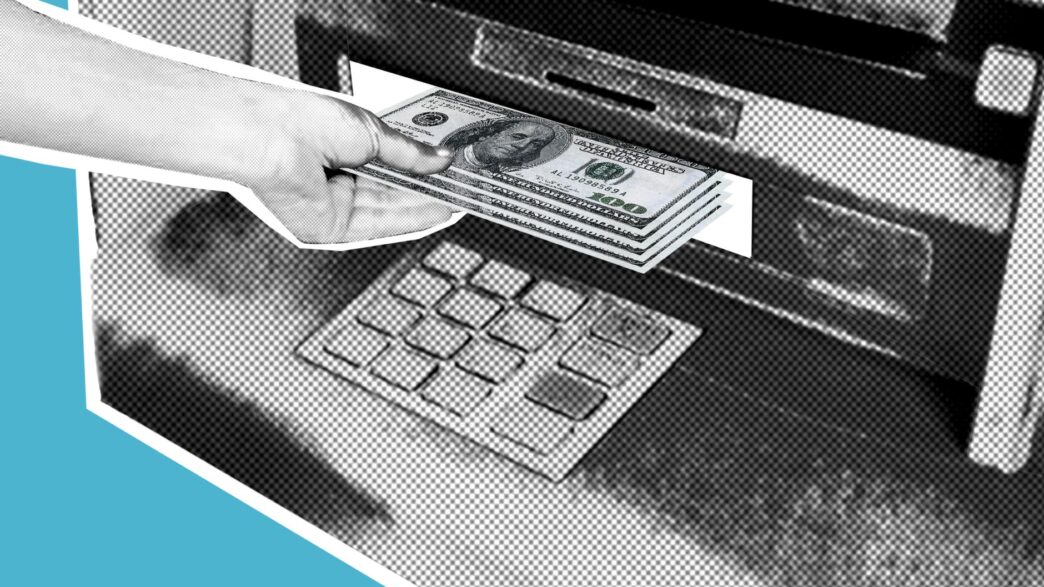
Pull $60 out of the wrong machine and you hand over $4.86 before you have bought anything. That is a shade over eight percent of the cash you asked for. ATM fees do not register as a percentage, because the screen shows you a flat dollar amount and a yes-or-no button, and that framing is doing a lot of work for the machine’s owner.
Two things about that charge go unmentioned almost everywhere. The number on the screen is not the whole fee. And the size of your withdrawal matters more than which machine you happen to be standing in front of.
That $4.86 was two separate fees, and only one of them is negotiable
An out-of-network cash withdrawal generates two charges. The company that owns the machine adds a surcharge, which averaged $3.22 in Bankrate’s 2025 Checking Account and ATM Fee Study. Then your own bank adds its own out-of-network fee for the trouble of routing the transaction, averaging $1.64. Together that is $4.86, a record for the third year running, and more than double the $1.97 average when the survey started in 1998. CBS News reported that in high-fee metros like Atlanta the combined average has been sitting above $5.30 since 2022.
Those two halves behave completely differently. The surcharge belongs to whoever owns the machine, and you cannot argue with it. The second fee belongs to your bank, which means a human at your bank has the authority to reverse it. Chase charges $3 for out-of-network domestic withdrawals. Bank of America and Wells Fargo each charge $2.50. All three refund those fees regularly for customers who call and ask, particularly first-time offenders and anyone with a longer account history.
The call takes four minutes. Ask for a courtesy refund of out-of-network ATM fees on your last statement, then ask a second question that matters more: does your account tier include a monthly ATM fee rebate allowance you are not using? Plenty of accounts quietly refund two or three out-of-network withdrawals a month, and the benefit sits unmentioned in a disclosure PDF.
Fewer people use ATMs every year, which is exactly why the fees keep climbing
The Federal Reserve released initial findings from its 2025 triennial payments study on July 1, 2026, and the numbers explain the whole trend. ATM cash withdrawals in the United States fell to 3.4 billion in 2024, down from 5.2 billion in 2015. Over that same stretch, the average withdrawal climbed from $134 to $210.
Read those two facts together. Machines cost roughly the same to install, stock, service, and insure whether they run 200 transactions a month or 90. When volume drops by a third, operators raise the per-transaction price to cover the same fixed costs. That is why “just use in-network machines” is advice with a shelf life: banks keep shrinking their branch and ATM footprints, so the odds that a convenient machine is yours keep falling.
This is not a fringe cost either. The FDIC’s 2023 National Survey of Unbanked and Underbanked Households found that almost every banked household used an in-person channel, an ATM or a teller, at least once during the year. Cash is a smaller share of spending than it used to be, and it is more expensive per trip than it has ever been.
Your withdrawal size, not your ATM choice, sets your real fee rate
Say you take out $60 twice a month at whatever machine is nearby. That is 24 withdrawals a year, 24 fees, and $116.64 gone. You withdrew $1,440 of your own money over those twelve months and paid 8.1 percent for access to it.
Now change one thing. Same person, same year, one withdrawal a month of $250 instead. Twelve fees, $58.32 total, on $3,000 of cash. The effective rate drops to 1.9 percent, and you are carrying more cash so you are less likely to need an unplanned second trip. You cut the cost by half without switching banks, downloading anything, or changing where you get cash.
Then change the second thing. Make that one monthly trip to a machine inside your network and the $58.32 goes to zero. These two levers multiply, and most advice on ATM fees hands you only the second one, which happens to be the harder habit to keep.
The obvious objection is that nobody wants $250 in their wallet. So do not put it there. Pull the month’s cash in one trip, leave most of it somewhere secure at home, and carry a week at a time, the same way you would ration anything else you buy in bulk. If $250 still feels like too much, $120 twice a month gets you most of the savings. This is also a decent moment to check how much cash you actually spend, which is a different question from how often you visit an ATM, and one that how much you keep in checking tends to obscure.
The surcharge-free network you already belong to
Most banks and credit unions do not own many machines. They rent access to a shared network, and that network is usually enormous. Allpoint runs more than 55,000 surcharge-free ATMs inside CVS, Walgreens, Target, Kroger, and Speedway stores. MoneyPass covers roughly 40,000. CO-OP gives credit union members close to 30,000 machines plus more than 5,500 shared branches, which is the genuinely underused one: as a member of almost any credit union, you can walk into a completely different credit union’s branch and make a withdrawal from your account at the teller window for free.
Most people never find this out because nothing prompts them to. Open your banking app, find the ATM locator, and note which network name appears. Then check the Allpoint locator against the places you actually go: the pharmacy near work, the grocery store you visit on Saturdays. If a surcharge-free machine sits on a route you already drive, your ATM fees are effectively over.
Two smaller traps worth closing. Cash back at the register is free at most grocery and drugstore chains, though the limit is usually $20 to $100 per transaction. And a balance inquiry at an out-of-network machine can trigger its own separate fee, so check your balance in the app before you walk over, not on the keypad.
When it is worth moving your checking account to end ATM fees permanently
If you have run the math and you are still looking at $100 or more a year, the account itself is the problem. Schwab Bank Investor Checking rebates unlimited ATM fees worldwide on cash withdrawals, with no monthly fee and no minimum. Their disclosure is specific about what does not qualify: balance inquiries, merchant point-of-sale fees, and currency conversion charges. Cash withdrawals are covered, which is the part that costs you.
Several credit unions and online banks refund a set dollar amount per statement cycle instead, commonly $10 to $20, which covers two to four out-of-network trips. That is usually enough.
Do not move an account only to chase a rebate, though. Direct deposit, bill pay, and any linked savings have to move with it, and a botched switch costs more in late fees than the ATM fees ever did. Treat the rebate as a tiebreaker between two accounts you would be happy with anyway.
If you only do one thing this week, make it the phone call, because it pays immediately and it tells you whether your account already has a rebate allowance sitting unused. The withdrawal-size fix costs nothing and takes effect the next time you need cash. ATM fees have hit a record high three years running, and the Fed’s own transaction data says the pressure pushing them up is not going to let go. Nothing about that is worth eight percent of your grocery money.